
🪐 Discover more about our solar system! 🪐
👇🏻 Click on a planet to discover more about it! 👇🏻
Sun

| Distance | Diameter | Mass | Day | Year | Avg Temp |
|---|---|---|---|---|---|
| 0 km | 1,391,000 km | 333,000 M⊕ | 25.4 days | — | 5,500°C |
The Sun is the center of our Solar System, a massive sphere of incandescent plasma that provides the energy necessary for life on Earth. Composed primarily of hydrogen and helium, the Sun generates energy through nuclear fusion in its core, converting hydrogen into helium and releasing immense amounts of light and heat.
With a diameter of about 1.39 million kilometers, the Sun contains 99.8% of the mass of the entire Solar System. It has been revered in nearly all ancient cultures as a divine or celestial being — from the Egyptian Ra to the Greek Helios.
The Sun has an approximate surface temperature of 5,500°C and a core temperature exceeding 15 million°C. It follows an 11-year solar cycle marked by sunspots, solar flares, and changes in magnetic activity.
Currently about 4.6 billion years old, the Sun is expected to burn for another 5 billion years before evolving into a red giant and eventually becoming a white dwarf.
Mercury
| Distance | Diameter | Mass | Day | Year | Avg Temp |
|---|---|---|---|---|---|
| 58 mln km | 4,879 km | 0.055 M⊕ | 59 days | 88 days | 167°C |
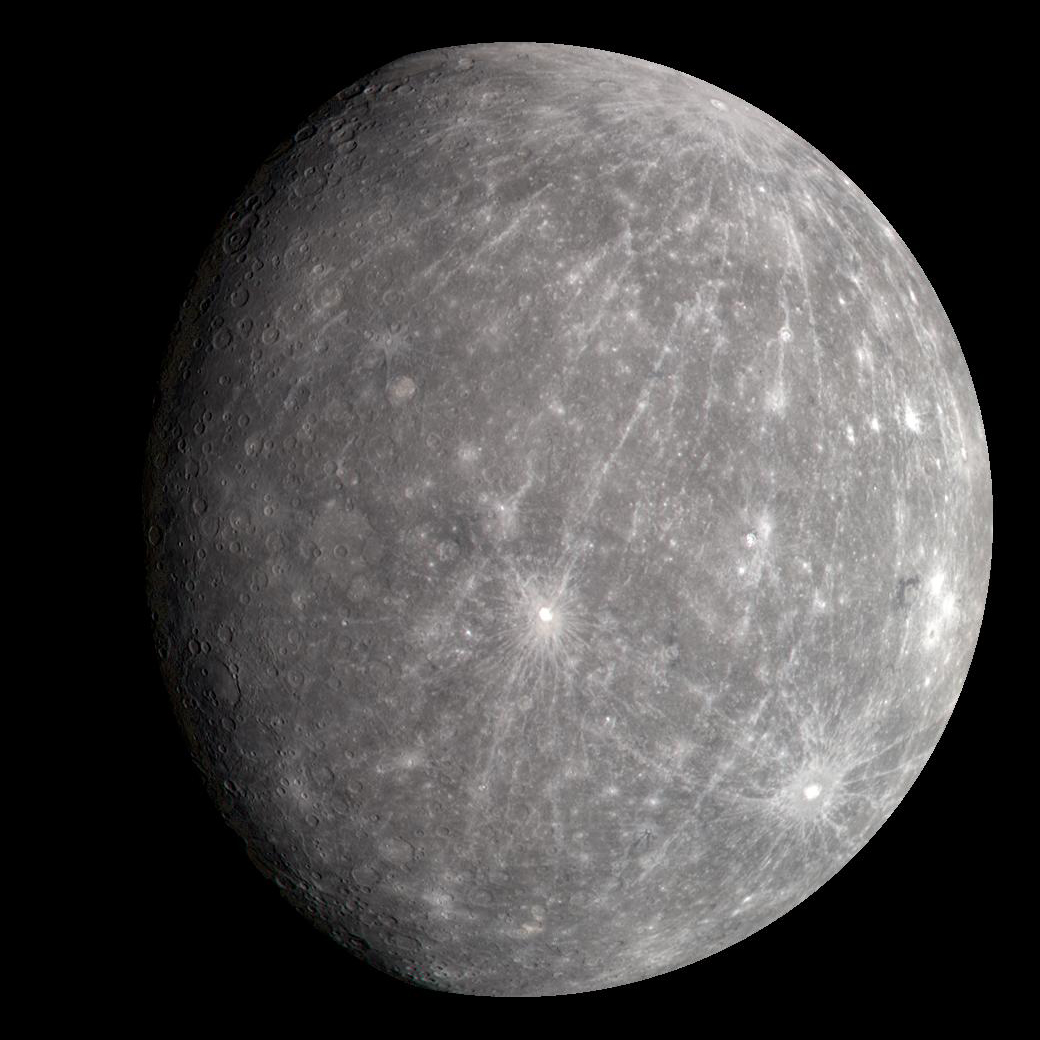
Mercury is the closest planet to the Sun and the smallest in the Solar System. Despite its size, it has a dense metallic core and a heavily cratered surface, resembling our Moon. It lacks a substantial atmosphere, which leads to extreme temperature fluctuations between day and night.
Mercury was known since ancient times and observed by Babylonian astronomers as early as the 14th century BCE. Because it never strays far from the Sun in the sky, it can only be observed during twilight hours — just before sunrise or after sunset. The planet’s name comes from the Roman messenger god Mercury, likely due to its rapid movement across the sky.
Interestingly, a day on Mercury (sunrise to sunrise) lasts about 176 Earth days, while its year is only 88 Earth days long. That means a single day on Mercury is longer than its entire year! The planet has been visited by only two spacecraft: Mariner 10 in the 1970s and more recently, the MESSENGER mission (2004–2015), which mapped the entire surface and discovered water ice in shadowed craters near the poles.
Venus
| Distance | Diameter | Mass | Day | Year | Avg Temp |
|---|---|---|---|---|---|
| 108 mln km | 12,104 km | 0.815 M⊕ | 243 days (retro) | 225 days | 464°C |
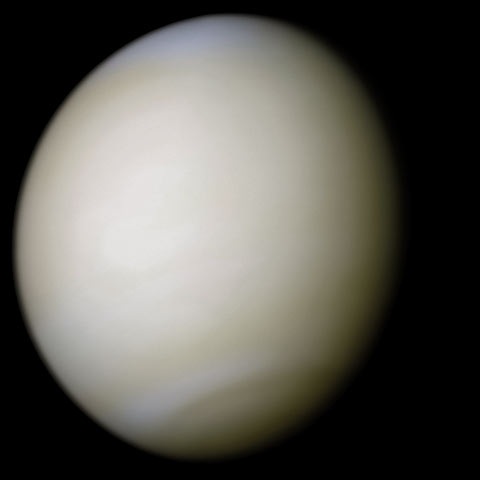
Venus is often called Earth’s “sister planet” because of its similar size and composition. However, its environment is wildly different: Venus has a thick, toxic atmosphere composed mostly of carbon dioxide, with clouds of sulfuric acid, and surface temperatures hot enough to melt lead.
Like Mercury, Venus was known since antiquity. It was often mistaken for two separate stars: the “Morning Star” and the “Evening Star,” depending on its position relative to the Sun. The planet is named after the Roman goddess of love and beauty, the only one of the classical planets named after a female figure.
Venus rotates in the opposite direction compared to most other planets — a phenomenon called “retrograde rotation.” One day on Venus lasts about 243 Earth days, while its year is only 225 days long. Despite this, the Sun rises every 117 Earth days due to the interplay of rotation and revolution.
The Soviet Union was the first to successfully land a probe on Venus. The Venera missions in the 1970s returned the first and only images from its surface — before being destroyed by the intense pressure and heat in just a few minutes.
Earth
| Distance | Diameter | Mass | Day | Year | Avg Temp |
|---|---|---|---|---|---|
| 150 mln km | 12,742 km | 1 M⊕ | 24 hrs | 365.25 days | 15°C |
Earth is the third planet from the Sun and the only known world to harbor life. Its atmosphere, magnetic field, liquid water, and moderate climate make it uniquely suitable for life as we know it.
Earth has a dynamic geology with shifting tectonic plates, active volcanism, and erosion cycles that constantly reshape its surface. Its single natural satellite, the Moon, is thought to have formed from a giant impact early in Earth’s history.
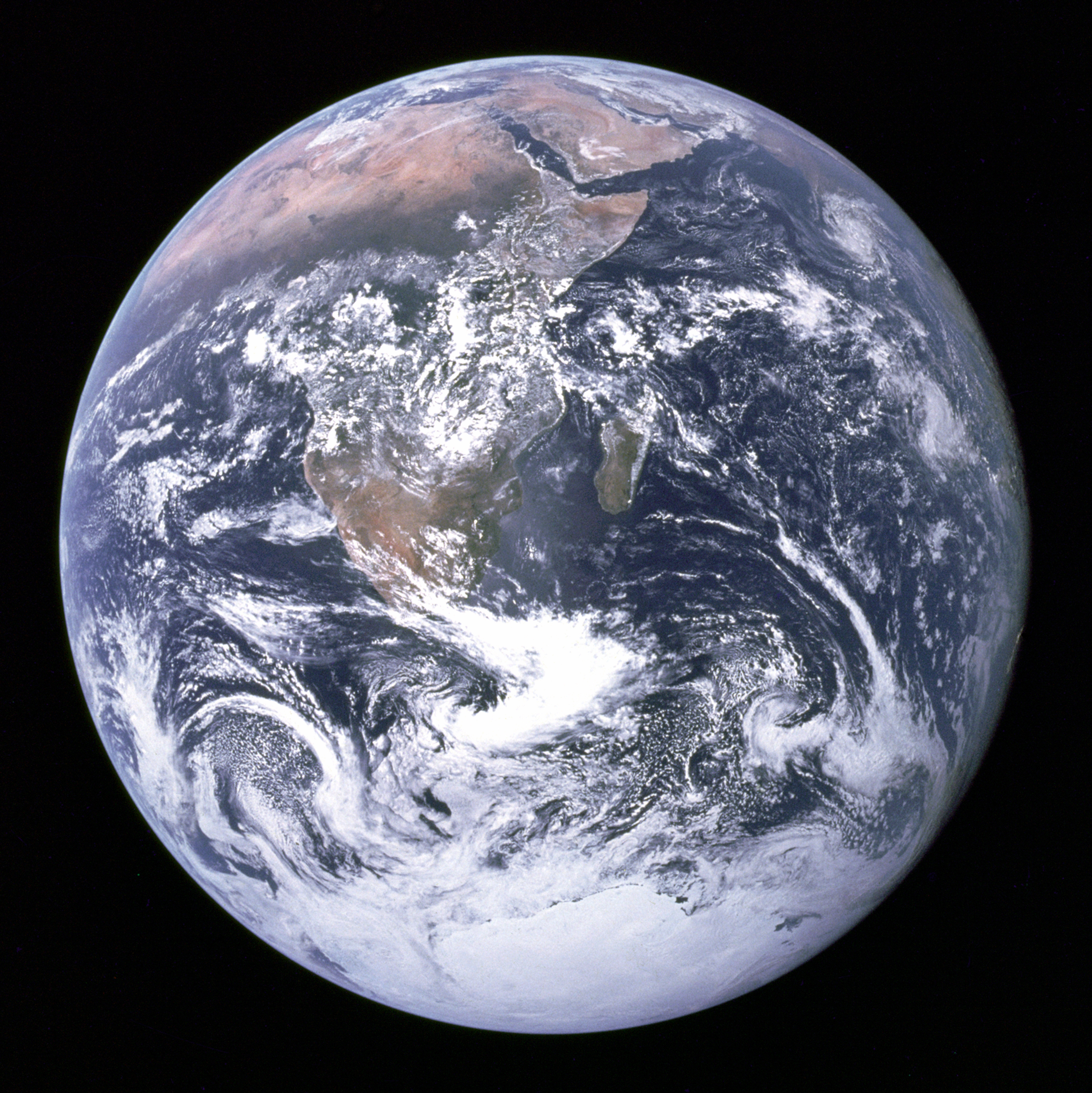
Humanity has been observing and mapping the Earth for millennia, but only in the past few decades have we seen it from space. The “Blue Marble” photo taken by Apollo 17 in 1972 remains one of the most iconic images of our planet.
Earth completes one orbit around the Sun in about 365.25 days and rotates once every 24 hours. The slight tilt of its axis (23.5°) is what gives us seasons. Earth is home to more than 8 million species and over 7.8 billion people.
Mars

| Distance | Diameter | Mass | Day | Year | Avg Temp |
|---|---|---|---|---|---|
| 228 mln km | 6,779 km | 0.107 M⊕ | 24.6 hrs | 687 days | -65°C |
Mars, the fourth planet from the Sun, is often referred to as the “Red Planet” due to the iron oxide (rust) on its surface. Its thin atmosphere and relatively low temperatures make it a cold and arid world, but also a tantalizing target for exploration.
The planet was named after the Roman god of war. Its reddish hue has fascinated observers since antiquity. The first telescopic observations in the 17th century revealed polar caps and seasonal changes, sparking speculation about alien life.
In the 19th century, astronomer Giovanni Schiaparelli described what he thought were “canali” (channels) on Mars — mistranslated as “canals,” fueling myths of Martian civilizations. Though now debunked, Mars remains one of the best candidates for past (and possibly future) life.
Several missions have visited Mars, from Viking to the Curiosity and Perseverance rovers. Mars has the tallest volcano (Olympus Mons) and one of the largest canyons (Valles Marineris) in the Solar System.
Jupiter
| Distance | Diameter | Mass | Day | Year | Avg Temp |
|---|---|---|---|---|---|
| 778 mln km | 139,820 km | 317.8 M⊕ | 9.9 hrs | 11.9 yrs | -110°C |
Jupiter is the largest planet in the Solar System, a gas giant more massive than all other planets combined. Its composition is mostly hydrogen and helium, and it lacks a solid surface.
Known since ancient times, Jupiter was named after the king of the Roman gods. Galileo Galilei famously observed its four largest moons — Io, Europa, Ganymede, and Callisto — in 1610, providing early evidence that not all celestial bodies orbit the Earth.
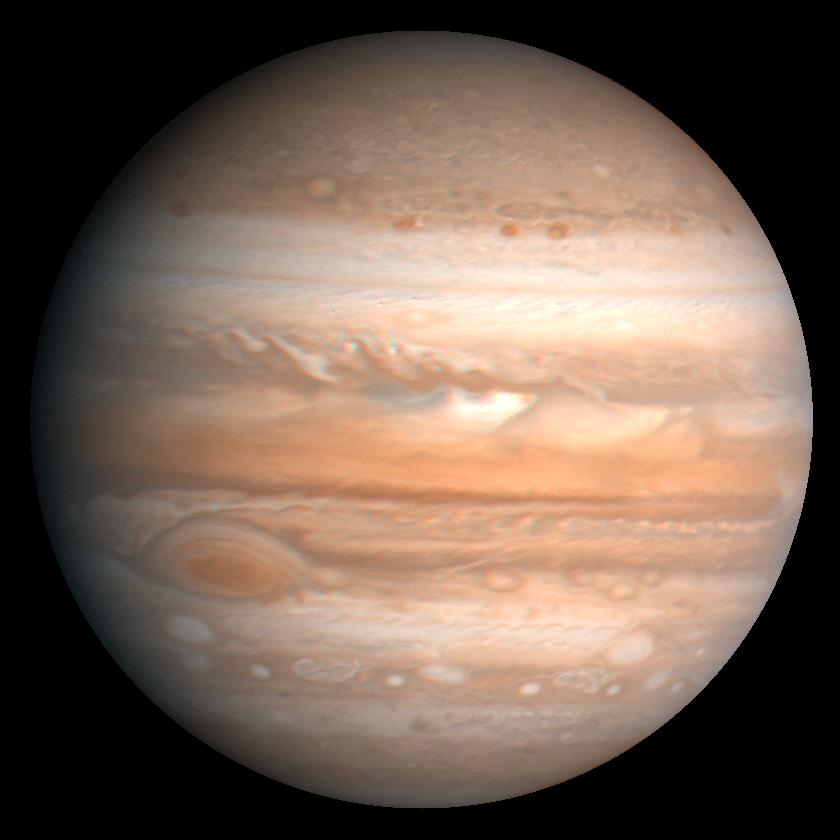
Jupiter is home to the Great Red Spot, a gigantic storm larger than Earth that has raged for centuries. The planet has a powerful magnetic field and at least 95 confirmed moons.
NASA’s Juno spacecraft is currently studying Jupiter’s atmosphere and internal structure, providing the most detailed data ever collected about this gas giant.
Saturn

| Distance | Diameter | Mass | Day | Year | Avg Temp |
|---|---|---|---|---|---|
| 1.43 bln km | 116,460 km | 95.2 M⊕ | 10.7 hrs | 29.5 yrs | -140°C |
Saturn is best known for its stunning ring system, made of ice and rock particles. It’s the second largest planet in the Solar System and a gas giant like Jupiter.
Saturn has been known since antiquity and was named after the Roman god of agriculture. It has at least 83 confirmed moons, including Titan — the second-largest moon in the Solar System, with lakes of liquid methane.
The Cassini mission (1997–2017) orbited Saturn for 13 years, sending back breathtaking images and discovering active geysers on the moon Enceladus, which may indicate a subsurface ocean.
Despite its size, Saturn is the least dense planet; it would float in water if a large enough body existed. Its atmosphere features banded clouds and massive storms, similar to those of Jupiter.
Uranus
| Distance | Diameter | Mass | Day | Year | Avg Temp |
|---|---|---|---|---|---|
| 2.87 bln km | 50,724 km | 14.5 M⊕ | 17.2 hrs (retro) | 84 yrs | -195°C |
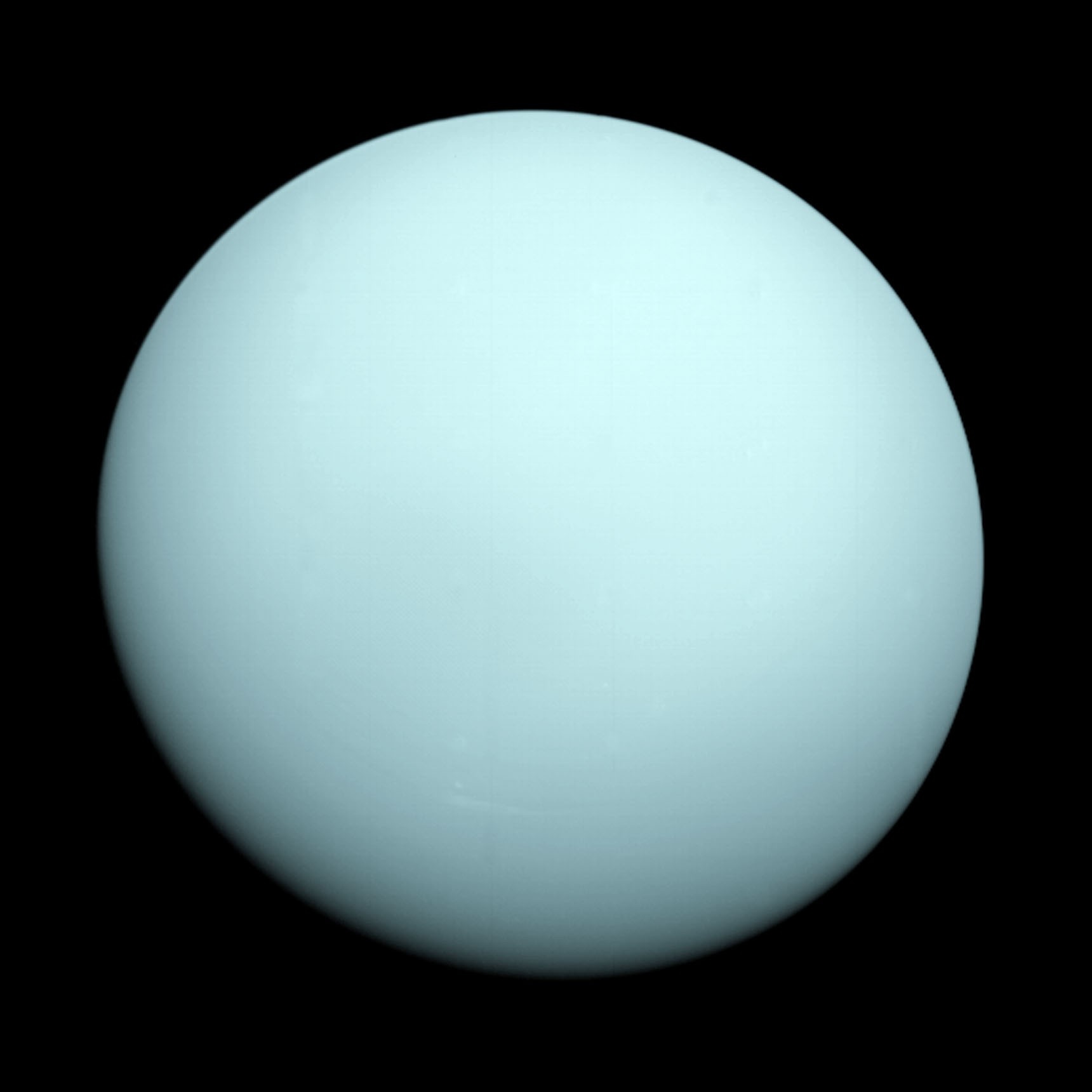
Uranus is an ice giant with a pale blue color caused by methane in its upper atmosphere. It was the first planet discovered with a telescope, by William Herschel in 1781.
Uniquely, Uranus rotates on its side — its axis is tilted by about 98°, possibly due to a massive ancient collision. This gives rise to extreme seasons, with each pole getting 42 years of continuous sunlight or darkness.
Uranus has a faint ring system and 27 known moons, many named after characters from Shakespeare and Alexander Pope. Its atmosphere is colder than any other planet, reaching -224°C.
Voyager 2 is the only spacecraft to have visited Uranus, flying by in 1986 and revealing a smooth, featureless appearance — though later observations suggest it may host massive storms.
Neptune

| Distance | Diameter | Mass | Day | Year | Avg Temp |
|---|---|---|---|---|---|
| 4.5 bln km | 49,244 km | 17.1 M⊕ | 16.1 hrs | 165 yrs | -200°C |
Neptune is the eighth and farthest known planet from the Sun. It’s a deep blue ice giant, discovered in 1846 based on mathematical predictions rather than direct observation.
The discovery of Neptune confirmed Newtonian mechanics and demonstrated the power of celestial mechanics. It was later observed by Johann Galle, following predictions by Urbain Le Verrier and John Couch Adams.
Neptune has supersonic winds, the fastest in the Solar System, reaching over 2,000 km/h. It also features a large dark storm similar to Jupiter’s Great Red Spot.
Its largest moon, Triton, orbits in the opposite direction of Neptune’s rotation, suggesting it was likely a captured object. Triton is geologically active, with cryovolcanoes that eject nitrogen.